Score |
159







The City That Was Never Yours
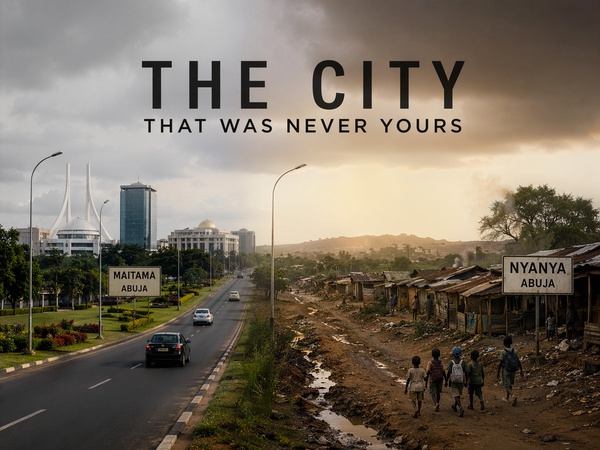
<p>There is a version of Abuja that exists in photographs — wide roads, manicured lawns, embassies gleaming in the afternoon light. Politicians live there. Ambassadors live there. Empty houses live there.</p><p> </p><p>Over 45,000 of them.</p><p> </p><p>Fully furnished. Sitting in Maitama and Asokoro like held breath.</p><p> </p><p>And thirty minutes away, in Nyanya and Karu, children are learning on bare floors in classrooms whose roofs have already made peace with the rain.</p><p> </p><p>Sit with that for a moment — not as a statistic, but as geography. Same city. Thirty minutes apart.</p><p> </p><p>Abuja was not supposed to be this.</p><p> </p><p>It was designed — master-planned, deliberate — a capital built to carry the weight of Nigeria’s promise. The original vision included rail connections linking satellite towns to the city centre, so that the people who kept the capital running could actually live near it.</p><p> </p><p>That plan never fully materialized.</p><p> </p><p>What materialized instead is this: a city that quietly decided who it was built for.</p><p> </p><p>In 2025, the Minister of the FCT, Nyesom Wike, said it plainly: “Poor people do not live in Maitama, Wuse 2, Guzape, Asokoro, and the Central Business Areas of Abuja.”</p><p> </p><p>He was not apologizing. He was not describing a problem.</p><p> </p><p>He was stating policy.</p><p> </p><p>And in that sentence, he revealed what Abuja has been becoming all along.</p><p> </p><p>The numbers give that truth a body.</p><p> </p><p>More than half of Abuja’s residents live in poverty — in the same city where property in prime districts ranges from ₦35 million to ₦100 million, where luxury flats exceed ₦313 million, where a mansion in Maitama can list for ₦15 billion.</p><p> </p><p>A mid-career journalist with a housing allowance of ₦41,000 admits he has no realistic path to ownership. A civil servant watched her rent double in two years — from ₦550,000 to ₦1 million — and said the most honest thing you can say about life here:</p><p> </p><p>*“It’s like we are trapped.”*</p><p> </p><p>She is right.</p><p> </p><p>The trap is structural — and I know because I’ve lived inside it.</p><p> </p><p>I school at the University of Abuja, near Gwagwalada. Cross the airport junction heading outward and the streetlights disappear. Just like that. The road folds into darkness, and you understand exactly where the city’s concern for you ends.</p><p> </p><p>Places like Giri and Iddo — communities with thousands of people — barely register on a map.</p><p> </p><p>Yet a single room there costs over ₦100,000. A self-contained apartment goes for ₦350,000 to ₦700,000.</p><p> </p><p>Student settlements. No consistent light. No reliable roads. No network once you leave the centre — your phone becomes decorative the moment Abuja stops caring about your neighbourhood.</p><p> </p><p>But the rent?</p><p> </p><p>The rent kept up with Maitama just fine.</p><p> </p><p>This is what makes Abuja different from Lagos — or any city where inequality exists.</p><p> </p><p>Lagos grew. It sprawled. It became what it is through pressure, movement, accident.</p><p> </p><p>Abuja was built.</p><p> </p><p>Every road. Every zoning decision. Every demolition order.</p><p> </p><p>These are not accidents.</p><p> </p><p>They are choices.</p><p> </p><p>And the choices have been made, consistently, in favour of the same people.</p><p> </p><p>The FCT administration continues to demolish informal settlements in the name of a master plan it has selectively ignored for decades — displacing people who, in many cases, consider these places home.</p><p> </p><p>A senator once called these settlements an “eyesore” near the airport. He was worried about what visitors would think.</p><p> </p><p>He was not worried about where those people would go.</p><p> </p><p>Meanwhile, ₦39 billion was approved for an ICC Centre. Judges’ quarters were renovated. The Court of Appeal complex received attention.</p><p> </p><p>Over 20,000 children are currently out of school because their classrooms are no longer structurally safe to enter.</p><p> </p><p>If the administration can commit billions to an ICC Centre, it can commit the same seriousness to education.</p><p> </p><p>It simply chooses not to.</p><p> </p><p>Oxfam put it plainly: inequality in Nigeria is not accidental — it is the result of deliberate policy choices.</p><p> </p><p>The top 10 percent control 32.5 percent of national income.</p><p> </p><p>The poorest 10 percent hold 2.3 percent.</p><p> </p><p>These numbers did not arrive.</p><p> </p><p>They were arranged.</p><p> </p><p>But what lingers is the emptiness.</p><p> </p><p>Forty-five thousand homes, sitting vacant in the most expensive parts of a city where children cannot find a dry floor to learn on.</p><p> </p><p>That emptiness is not inefficiency.</p><p> </p><p>It is a statement.</p><p> </p><p>It says: this space exists for wealth to rest in, not for people to live in.</p><p> </p><p>And the people who are actually living — in Nyanya, Karu, Kuje, Giri — paying rents that have nearly doubled in three years, sharing water with animals, watching classrooms fall apart, losing network signal like losing oxygen the further they drift from the centre —</p><p> </p><p>they were never part of the Abuja being built.</p><p> </p><p>The city is at a crossroads.</p><p> </p><p>Not because the resources do not exist — they clearly do.</p><p> </p><p>But because the people who hold power must decide whether this is a city they are willing to be accountable for.</p><p> </p><p>Whether a capital’s worth is measured by the gleam of its embassies —</p><p> </p><p>or by whether the children thirty minutes away have a ceiling that holds.</p><p> </p><p>The divide is widening.</p><p> </p><p>But it is not permanent.</p><p> </p><p>The only question that matters is this:</p><p> </p><p>Will anyone in that gleaming city centre look thirty minutes outward —</p>



 76
76





Other insights from Matthew Okibe








Referral Earning

Points-to-Coupons

Insights for you.







THE MEETING
Sometimes it takes one meeting for our lives to change forever. It was never Femi'...
1360 views
14 upvotes
15 comments



OMÓ ÉSAN
They say the apple does not fall far from the tree, but I was the exception, or I was s...
1302 views
15 upvotes
10 comments


































Comments