


True
;
International Criminal and Human Rights Lawyer
This Session has closed
About Arrey Ojong Collins
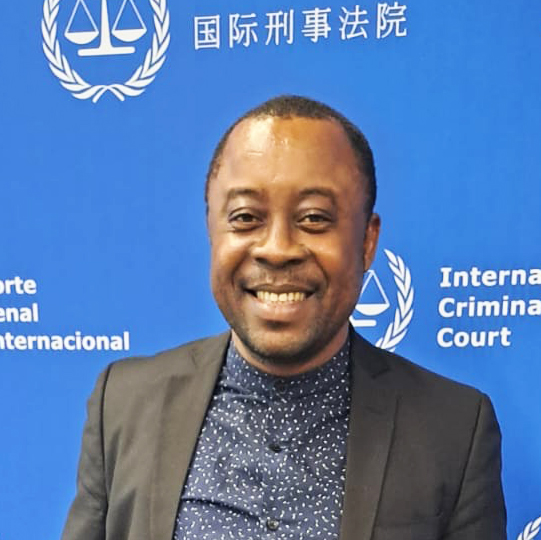
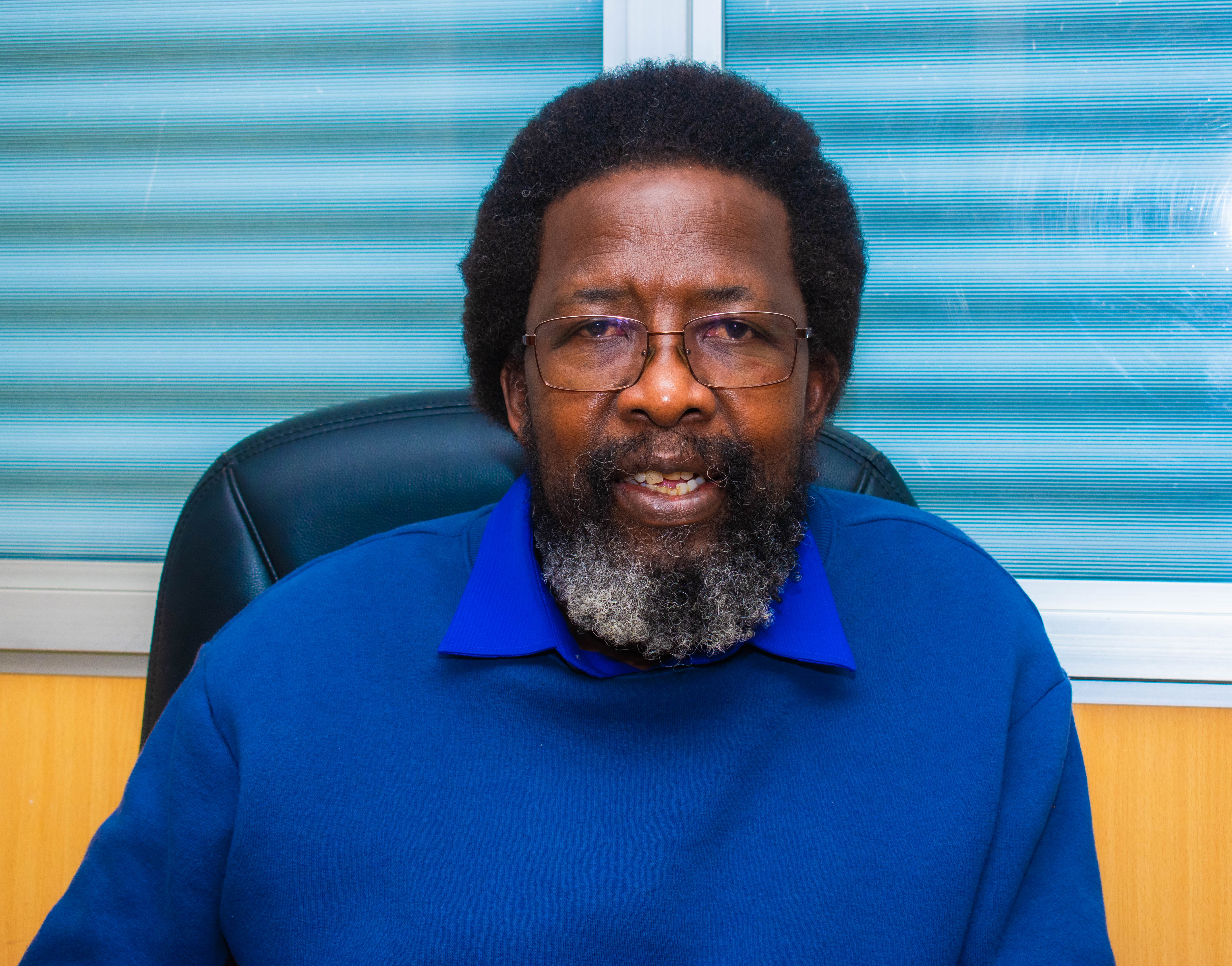
Arrey Collins is an International Criminal & Human Rights Lawyer on the List of Counsel before the International Criminal Court (ICC), The Hague, Netherlands. He equally serves as Country Director; International Human Rights Council, Cameroon. Before joining the ICC, Arrey Collins gained extensive international experience, through trainings with the Media Legal Defense Initiative (now Media Defense), London. This experience introduced him to advocacy on the rights of freedom of expression (online and offline) and human rights litigation before the African Commission and the African Court on Human and Peoples’ Rights (ACHPR & AfCHPR). He also trained at the International Institute of Humanitarian Law (IIHL), Sanremo in Italy and the Centre for Human Rights at the University of Pretoria, South Africa. He holds an LL.M. in Transnational Crime and Justice from University for Peace/United Nations Interregional Crime and Justice Institute, Turin-Italy He is founder of Arrey & Associates Law Office, Limbe-Cameroon and a Corresponding Advocate at Barreau du Metz, France.
INTERVIEW
QUESTIONS
These interview questions were brought to you by TwoCents and Victor Ntamugabumwe

TwoCents

You have trained and worked across multiple countries and legal systems. How has this international exposure influenced your approach to justice and advocacy?

ARREY OJONG Collins ARREY OJONG Collins
A rules based-international order, grounded in accountability remains essential for safeguarding the rights and security of present and future generations.

3
comments 0

TwoCents

For young Africans aspiring to careers in international law or human rights, what skills or experiences do you believe matter most beyond academic qualifications?

ARREY OJONG Collins ARREY OJONG Collins

Focus, determination, consistency and integrity. 

3
comments 0

TwoCents

There has been significant global attention around the recent arrest warrant issues involving Benjamin Netanyahu at the International Court of Justice. From your perspective as an international human rights and humanitarian lawyer, how should people understand the role of international courts in such high-profile cases, and what does this moment mean for international justice more broadly?

ARREY OJONG Collins ARREY OJONG Collins

 As a judicial institution, the ICC does not have its own police force or enforcement body. It relies on cooperation  with all states for making arrest, transferring of arrested persons to the ICC detention centre in The Hague, freezing of suspect's assets, and enforcing sentences.


2
comments 0

TwoCents

Your career spans advocacy, humanitarian work, and international criminal justice—how did each stage shape the lawyer you are today?

ARREY OJONG Collins ARREY OJONG Collins
I started as  domestic lawyer/general legal practitioner in Cameroon with a special focus on pro-bono defence of every impecunious person I came across who was in need of justice,  victims of prolonged detention, illegal arrest etc. During those early days as a legal practitioner, I realized I needed better professional skills in understanding  human rights protection which motivated me to join civil society and this exposed me to a good number of trainings/workshops/capacity building at the national level.
Subsequently, some international / non-governmental organizations funded a number of my trainings on human rights protection at the regional level in a number of African countries.
After these trainings in human rights protection at the African level coupled with field work in the crisis affected  English speaking regions in Cameroon, I felt the need to acquire training and education in protecting  victims of armed conflict. This motivated me to approach the International Institute of Humanitarian law in Sanremo Italy   and they  engaged  me into professional programs on International humanitarian law and later recommended  I undertook the Professional Master Programme offered by University for Peace  and United Nations Interregional crime and Justice Institute(UNICRI)
Lastly, studies at UNICRI introduced me to the work of the ICC which greatly aligned to my previous work, trainings and studies.

3
comments 0

TwoCents

Many people often confuse the International Criminal Court (ICC) with the International Court of Justice (ICJ). Could you explain the key differences between the two, what each court is responsible for, and why that distinction matters in today’s global justice conversations?

ARREY OJONG Collins ARREY OJONG Collins
The Jurisdiction of The International Court of Justice is to adjudicate on contentious issues between states (not individuals) and giving advisory opinion, mainly on implementation of treaties. While the International Criminal Court's  jurisdiction is grounded by "individual criminal responsibility" principle .Meaning the ICC adjudication is against individuals (physical persons) suspected or accused of committing the  four core ICC crimes as provided by the Rome Statute (War crime, Crimes against humanity, genocide and the crime of aggression).

3
comments 0

TwoCents

In your experience, what are the biggest misconceptions people have about the work of the International Criminal Court?

ARREY OJONG Collins ARREY OJONG Collins
Whatever misconception that exist about the work of the ICC, I can not tell, but all I have to say is; the crimes within the Court's jurisdiction are genocide, crimes against humanity, war crimes and the crime of aggression, represent the gravest violations of human rights and the international rule of law. Through the Court's judicial mandate, the Court seeks to uphold accountability for these crimes and in doing so, prevent future violations.

3
comments 0

TwoCents

What first drew you to human rights and humanitarian law, and was there a defining moment that set you on this path?

ARREY OJONG Collins ARREY OJONG Collins
There is always a defining moment protecting fundamental rights which should be a common concern of humanity as a whole.

3
comments 0

TwoCents

There has been a theory before that the International Criminal Court was set up to punish Africans as a control measure in the broader geopolitical landscape. Is the theory justified.

ARREY OJONG Collins ARREY OJONG Collins
In my opinion the theory is grossly false . The International Criminal Court serves as a global mechanism for justice. It is the first permanent court to prosecute  individuals for crimes ( war crimes, genocide,  crimes against humanity and aggression )  when national courts have fail to prosecute them. It is the court of last resort to end impunity,, deter atrocities, and support victims. Pending cases before the Court are not situations only from Africa, for instance, the Situation of Philippine is ongoing, there are arrest warrants pending execution like in the situation of Ukraine. There are equally a good number of cases  under investigations like, Venezuela, Bangladesh/Myanmar, State of Palestine, Georgia etc.
lastly and most importantly, most of the cases from Africa to the ICC were self referrals by those states themselves and  I think only two situations from the African continent were triggered by the UN Security Council resolution (Darfur-Sudan and Lybia).


3
comments 0

TwoCents

What was the transition like moving from regional and civil society work into an institution as global and complex as the ICC?

ARREY OJONG Collins ARREY OJONG Collins
International criminal justice is mainly a blend of International Humanitarian Law(IHL) and International Human Rights law (IHRL). 
I started as a domestic criminal and human rights lawyer, alongside civil society work on human rights protection,  which later exposed me to funded international trainings and short term assignments in different parts of the world within the focus of IHL and IHRL.
After obtaining a good number of certifications from training and field work in these two fields, I was opportune to receive an offer from the United Nations Interregional Crime and Justice Institute  to undertake and LLM in Transnational Crime and  Justice, this particular certification which complemented my previous short profession certifications was my main gateway to global justice.

2
comments 0

TwoCents

What is the appetite of the ICC Prosecutor towards Countries prosecuting their own suspects for war crimes and crimes against Humanity after the domestication of the Rome Statute vis-à-vis insisting on the prosecution under the ICC.

ARREY OJONG Collins ARREY OJONG Collins

The International Criminal Court is a court of last resort and under its complementarity principle, The ICC is intended to complement, not to replace national criminal systems, it prosecutes cases only when states are unwilling or are unable to genuinely do so.

2
comments 0

Be the first to ask ARREY OJONG a question

What is TwoCents? ×