
<p>When developing software or any kind of system, one of the most important things is making sure everyone understands what is actually needed.</p><p><br/></p><p>That’s where requirement documents come in. They help users, developers, and project teams stay on the same page and avoid misunderstandings later on.</p><p><br/></p><p>There are three main types of requirements documents you’ll often hear about: User Requirement Specification (URS), Software Requirement Specification (SRS), and System Requirement Specification (SysRS).</p><p><br/></p><p>Let’s talk about what each one means in simple, human terms.</p><p><br/></p><p>1. User Requirement Specification (URS)</p><p><br/></p><p>The URS is all about the user’s needs. It explains what the user wants the system to do, written in plain, everyday language that even non-technical people can understand.</p><p><br/></p><p>It focuses on the goals and expectations of the users without going into any technical explanation. For example, a URS might say:</p><p><br/></p><p>🌷 “The system should allow users to log in using their email and password.”</p><p><br/></p><p>Notice it doesn’t describe how the login will happen; it simply says what the user expects.</p><p><br/></p><p>In essence, the URS speaks the language of the end user, client, or stakeholder. It focuses on the outcome they want to see and keeps everything simple and easy to follow.</p><p><br/></p><p> 2. Software Requirement Specification (SRS)</p><p><br/></p><p>The SRS takes the user’s needs and translates them into technical details for the development team. This document is written for developers, testers, and project managers who need to understand how the software will actually work.</p><p><br/></p><p>It describes things like features, data flow, logic, and performance in more technical terms.</p><p><br/></p><p>For example, an SRS might say:</p><p>🌷 “The login module shall validate user credentials using the company’s authentication API and return a session token upon success.”</p><p><br/></p><p>Here, you can see it’s not just describing what should happen, but also how it should happen.</p><p><br/></p><p>The SRS focuses on how the software will be built to meet user needs. It is detailed, technical, and helps the technical team plan and execute the development effectively.</p><p><br/></p><p>3. System Requirement Specification (SysRS)</p><p><br/></p><p>The SysRS looks at the entire system, not just the software. It covers both hardware and software, as well as the networks, servers, and other elements that make everything work together.</p><p><br/></p><p>This document is often used by system engineers and IT administrators. It shows what kind of setup and environment the system needs to run smoothly.</p><p><br/></p><p>For instance, a SysRS might say:</p><p>🌷 “The system shall run on Windows 11 servers with a minimum of 16GB RAM and connect to the central database through a secure VPN.”</p><p><br/></p><p>The SysRS focuses on the complete system structure, from the physical setup to how each part connects and interacts. It ensures that everything behind the scenes supports the software efficiently.</p><p> </p><p><br/></p><p>Understanding these three documents helps you see how a simple idea transforms into a complete, working system. </p><p><br/></p><p>It begins with the user’s vision in the URS, moves into technical planning with the SRS, and then expands into the entire environment described by the SysRS.</p><p><br/></p><p>When each stage is clearly defined and understood, projects become easier to manage, communication becomes smoother, and the final product works exactly as intended.</p><p><br/></p><p>That’s the beauty of good documentation. It builds a bridge between what people want and what technology delivers.</p><p><br/></p><p><br/></p>
At the end of the month, we give out prizes in 3 categories: Best Content, Top Engagers and
Most Engaged Content.

Best Content
Top Engagers
Most Engaged Content
Best Content
We give out cash prizes to 7 people with the best insights in the past month. The 7 winners are picked
by an in-house selection process.
The winners are NOT picked from the leaderboards/rankings, we choose winners based on the quality, originality
and insightfulness of their content.
Here are a few other things to know for the Best Content track
1
Quality over Quantity — You stand a higher chance of winning by publishing a few really good insights across the entire month,
rather than a lot of low-quality, spammy posts.
2
Share original, authentic, and engaging content that clearly reflects your voice, thoughts, and opinions.
3
Avoid using AI to generate content—use it instead to correct grammar, improve flow, enhance structure, and boost clarity.
4
Explore audio content—high-quality audio insights can significantly boost your chances of standing out.
5
Use eye-catching cover images—if your content doesn't attract attention, it's less likely to be read or engaged with.
6
Share your content in your social circles to build engagement around it.
Top Engagers
For the Top Engagers Track, we award the top 3 people who engage the most with other user's content via
comments.
The winners are picked using the "Top Monthly Engagers" tab on the rankings page.
Most Engaged Content
The Most Engaged Content recognizes users whose content received the most engagement during the month.
We pick the top 3.
The winners are picked using the "Top Monthly Contributors" tab on the rankings page.
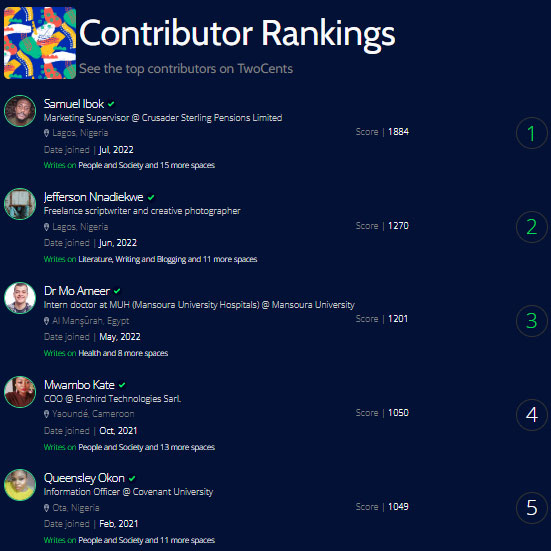
Contributor Rankings
The Rankings/Leaderboard shows the Top 20 contributors and engagers on TwoCents a monthly and all-time basis
— as well as the most active colleges (users attending/that attended those colleges)
The all-time contributors ranking is based on the Contributor Score, which is a measure of all the engagement and exposure a contributor's content receives.
The monthly contributors ranking tracks performance of a user's insights for the current month. The monthly and all-time scores are calcuated DIFFERENTLY.
This page also shows the top engagers on an all-time & monthly basis.
All-time Contributors
All-time Engagers
Top Monthly Contributors
Top Monthly Engagers
Most Active Colleges
Contributor Score
The all-time ranking is based on users' Contributor Score, which is a measure of all
the engagement and exposure a contributor's content receives.
Here is a list of metrics that are used to calcuate your contributor score, arranged from
the metric with the highest weighting, to the one with the lowest weighting.
1
Subscriptions received
2
Tips received
3
Comments (excluding replies)
4
Upvotes
5
Views
6
Number of insights published
Engagement Score
The All-time Engagers ranking is based on a user's Engagement Score — a measure of how much a
user engages with other users' content via comments and upvotes.
Here is a list of metrics that are used to calcuate the Engagement Score, arranged from
the metric with the highest weighting, to the one with the lowest weighting.
1
A user's comments (excluding replies & said user's comments on their own content)
2
A user's upvotes
Monthly Score
The Top Monthly Contributors ranking is a monthly metric indicating how users respond to your posts, not just how many you publish.
We look at three main things:
1
How strong your best post is —
Your highest-scoring post this month carries the most weight. One great post can take you far.
2
How consistent the engagement you receive is —
We also look at the average score of all your posts. If your work keeps getting good reactions, you get a boost.
3
How consistent the engagement you receive is —
Posting more helps — but only a little.
Extra posts give a small bonus that grows slowly, so quality always matters more than quantity.
In simple terms:
A great post beats many ignored posts
Consistently engaging posts beat one lucky hit
Spamming low-engagement posts won't help
Tips, comments, and upvotes from others matter most
This ranking is designed to reward
Thoughtful, high-quality posts
Real engagement from the community
Consistency over time — without punishing you for posting again
The Top Monthly Contributors leaderboard reflects what truly resonates, not just who posts the most.
Top Monthly Engagers
The Top Monthly Engagers ranking tracks the most active engagers on a monthly basis
Here is what we look at
1
A user's monthly comments (excluding replies & said user's comments on their own content)
2
A user's monthly upvotes
Most Active Colleges
The Most Active Colleges ranking is a list of the most active contributors on TwoCents, grouped by the
colleges/universities they attend(ed)
Here is what we look at
1
All insights posted by contributors that attended a particular school (at both undergraduate or postgraduate levels)
2
All comments posted by contributors that attended a particular school (at both undergraduate or postgraduate levels) —
excluding replies
Below is a list of badges on TwoCents and their designations.
Comments