Score |
144


Student @ Adekunle Ajasin University,Akungba Akoko Ondo State.Nigeria.




THE EXPECTATION IS TOO HIGH.
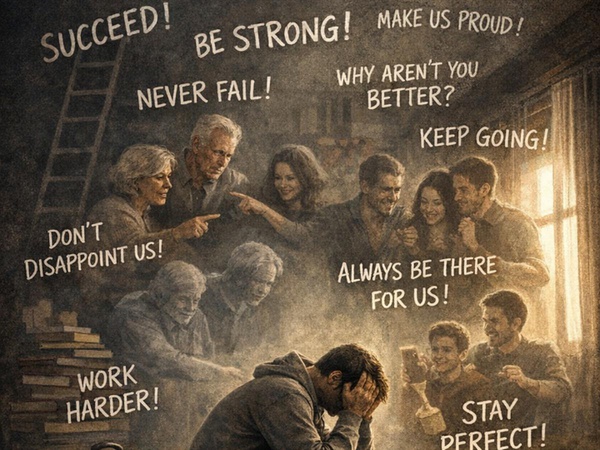
<p><br/></p><p>The expectation is too high—sometimes so high that it feels like living under a weight we did not choose but are constantly asked to carry. From the moment we become aware of ourselves, expectations begin to shape our lives. Life expects us to succeed without failing, people expect us to perform without breaking, family expects us to become proof that their sacrifices were worth it, and friends expect us to always show up whole, smiling, and strong. In the middle of all these demands, we are rarely asked a simple question: are you okay?</p><p>Life itself is demanding. It expects growth even when conditions are hostile, strength even when resources are scarce, and resilience even when rest is overdue. We are told to “make it” at a certain age, to have answers to questions we are still learning to ask. Life does not wait for healing before it pushes us forward. It keeps moving, and we are expected to keep pace—no pauses, no excuses. When we stumble, life is quick to remind us that others have survived worse, as if pain were a competition and endurance the only valid response.</p><p>People add another layer. Society expects us to fit into boxes it created—successful, responsible, disciplined, grateful. We are expected to inspire, to motivate, to be examples. When we do well, applause comes with pressure to do better. When we struggle, understanding is often short-lived. People admire strength but feel uncomfortable with vulnerability, so we learn to hide our cracks and perform wholeness. The expectation becomes not just to live, but to live impressively.</p><p>Family expectations often cut the deepest because they come wrapped in love, sacrifice, and obligation. We are expected to fulfill dreams that were deferred, to become answers to prayers we did not pray ourselves. In many homes, especially within our cultural contexts, failure is not seen as part of growth but as disgrace. Family expects gratitude expressed through achievement, obedience expressed through success. Even when unspoken, the pressure is loud: don’t disappoint us; don’t waste what we invested; don’t fall behind.</p><p>Friends, too, expect a version of us that is always available. The strong friend, the wise one, the helper, the listener—roles assigned without consent. We are expected to be present for others even when we are absent from ourselves. Saying “I’m tired” feels like betrayal, and needing help feels like weakness. So we carry not only our burdens but the emotional weight of maintaining connections.</p><p>What makes the expectation too high is not that people hope for our best, but that they often forget our humanity. We are allowed dreams, but rarely allowed delays. Allowed ambition, but rarely allowed exhaustion. In trying to meet every expectation, we lose touch with our own needs, our own pace, our own truth.</p><p>Perhaps the most radical thing we can do is to lower the noise of external expectations and listen inward. To accept that we are enough even when we are unfinished. That rest is not failure, and boundaries are not rebellion. Life may expect a lot, people may demand consistency, family may hope for greatness, and friends may rely on us—but we must also expect compassion from ourselves.</p><p>Because at the end of it all, living should not feel like an endless audition. We deserve a life where growth includes grace, where expectations make room for breath, and where being human is not something we have to apologize for.</p>


 75
75



Other insights from Abisolina












Referral Earning

Points-to-Coupons

Insights for you.



RECOVERING FROM A “GHOST”
Our generation is weird. Almost everyone I know has been ghosted at least once in their...
3161 views
19 upvotes
11 comments





Social media (in)tolerance?
I would like to believe that social media was created to bolster and improve communicat...
1974 views
10 upvotes
7 comments




LET'S TALK ABOUT FAKE FRIENDS
Quite often, we see post from contacts on our social media, about fake friends. Friends...
1476 views
9 upvotes
14 comments

MORALITY VS OUR LOVED ONES
It is no news that social media and maybe even the country is buzzing with the story of...
1416 views
5 upvotes
8 comments



What is the way forward?
“Any names yet? My nephew is from that school!”, cried a devastated aunt after getting ...
1395 views
10 upvotes
9 comments
































Comments