Score |
274








The City of Big Gates and Long Walks
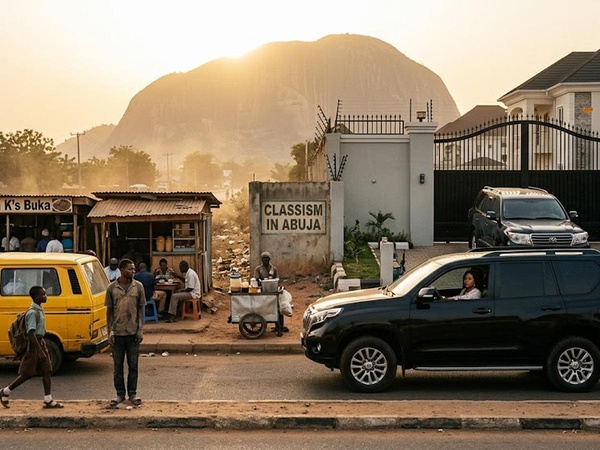
<p style="text-align: center;"> There is a certain way the sun sets in Abuja. It’s breathtaking. The sky turns a soft, hazy pink over the Aso Rock, and for a moment, the city looks like a dream. It looks like the <span style="font-weight: bold;">"Center of Unity"</span> it was promised to be. But as the streetlights flicker on in Maitama while the generators start their rhythmic thumping in Nyanya, you realize that unity is often just a word on a coat of arms.</p><p> People come here from every corner of Nigeria with a single goal: to<span style="font-weight: bold;"> "make it."</span> But as you spend more time here, you realize that Abuja is a city of layers, and those layers rarely blend.</p><p><br/></p><p> If you live here, you know the feeling. Abuja isn't just a city; it’s a collection of worlds that rarely touch, even when they’re standing right next to each other. </p><p><br/></p><p> <strong>The Silent Handshake.</strong></p><p><br/></p><p> Think about the first interaction most people have in the morning. It’s the <span style="font-weight: bold;">"Gateman."</span> He’s the one who swings open those heavy, black spiked gates so the SUV can glide out. There’s a<span style="font-weight: bold;"> "Good morning, Sah"</span> or a <span style="font-weight: bold;">"Well done, Ma,"</span> usually met with a nod or a brief wave. </p><p><br/></p><p> In that five second exchange, the class divide is wider than the Benue River. One person is heading to an air-conditioned office to make decisions that move millions while the other is returning to a tiny room behind the generator house, wondering if the money sent home to the village will cover the school fees this month. We live in the same compound, breathe the same air, and yet, we are light years apart. </p><p> Abuja runs on the labor of people we’ve trained ourselves not to see. Every morning, thousands of people trek across the bridge from Nyanya or Mararaba. They aren't walking for exercise; they are walking because the last leg of the journey to the <span style="font-weight: bold;">"City Center"</span> is a luxury they can’t afford every day.</p><p><br/></p><p> These are the hands that prune the lush gardens in Maitama and mop the floors of the glass-walled offices in Central Area. Yet, there’s a strange, unspoken rule: the more essential your work is to the city’s beauty, the more invisible you are supposed to be. We call everyone <span style="font-weight: bold;">"Oga"</span> or <span style="font-weight: bold;">"Madam" </span>as a sign of respect, but in Abuja, those words have become labels of power. We use them to establish who is serving and who is being served before a single meaningful word is even exchanged.</p><p><br/></p><p><strong> The View from the Traffic Light</strong></p><p><br/></p><p> Abuja’s traffic lights are where the masks slip. </p><p> In most cities, a car is just a way to get from point A to point B. In Abuja, your car is your social ID card. </p><p> You’re sitting in your car, maybe listening to a podcast or checking your phone. The AC is humming. Outside, a young boy, no older than ten, is weaving through the cars selling cold <span style="font-weight: bold;">"pure water"</span> or plantain chips. </p><p><br/></p><p> He looks at you through the glass. You look at him. For a split second, there’s a connection (two humans in the same space). But then the light turns green. You press the accelerator, and he disappears in your rearview mirror. You go to your world of brunch at Jabi Lake Mall, and he stays in his world of asphalt and exhaust fumes. In Abuja, your car isn't just transport; it’s your protective bubble from the reality of the streets.</p><p><br/></p><p> <strong>The Identity of the "Satellite"</strong></p><p><br/></p><p> We’ve even coded our classism into our geography. If you tell someone you live in<span style="font-weight: bold;"> "The City,"</span> it carries a certain weight. But if you say you live <span style="font-weight: bold;">"down the road" </span>in Mararaba, Lugbe, or Karu, the conversation often shifts. </p><p><br/></p><p> The people who make Abuja run the cleaners, the security guards, the office assistants, the teachers mostly live in these satellite towns. They spend three hours every morning fighting for space in a yellow<span style="font-weight: bold;"> “danfo” </span>or a cramped<span style="font-weight: bold;"> "Along" </span>car, just to reach the neighborhoods they can’t afford to live in. They build the mansions they will never be invited into as guests. They keep the city beautiful, yet the city often feels like it's trying to push them further and further to the fringes.</p><p><br/></p><p> Go to any high-end mall in Wuse II on a Saturday. You’ll see families dressed in designer labels, pushing carts filled with imported chocolates and expensive wines. Just outside the mall’s perimeter fence, there’s likely a<span style="font-weight: bold;"> "buka" </span>or a small kiosk where a construction worker is eating a plate of <span style="font-weight: bold;">*garri* </span>and soup, his only meal for the day.</p><p><br/></p><p> The fence isn't just made of wire and stone; it’s made of the prices on the menus and the look the security guard gives you at the entrance. In Abuja, classism isn't always a loud insult. Sometimes, it’s just the quiet realization that you don't <span style="font-weight: bold;">"belong" </span>in a certain building because of the shoes you’re wearing or the way you speak.</p><p><br/></p><p> <strong>The Invisible Fence</strong></p><p><br/></p><p> The most heart-wrenching part of classism in Abuja isn't the difference in bank balances; it’s the loss of empathy. It’s the way we’ve learned to look <span style="font-weight: bold;">*through*</span> people instead of<span style="font-weight: bold;"> *at*</span> them. We see the uniform, not the man. We see the<span style="font-weight: bold;"> "house help," </span>not the woman with a name, a story, and a dream of her own.</p><p><br/></p><p> We’ve built a city of big gates, but we’ve accidentally built them around our hearts, too. We’ve become so used to the divide that we don’t even notice when it’s widening. We talk about <span style="font-weight: bold;">"The Abuja Life" </span>as if it’s one experience, but for many, it’s a daily marathon just to stay at the starting line.</p><p><br/></p><p> We build these massive walls to keep the<span style="font-weight: bold;"> "other" </span>Abuja out, but the walls only highlight what’s missing: a bridge. We’ve become experts at navigating the city without ever truly seeing our neighbors. We worry about the<span style="font-weight: bold;"> "widening divide," </span>but we often forget that the divide is made of people, not just money.</p><p><br/></p><p> Abuja is a beautiful city, truly. But its real beauty shouldn't come from its paved roads or its grand fountains. It should come from the bridge we build between the person inside the gate and the person outside of it. Because at the end of the day, when the sun finally drops behind the hills, we are all just people looking for a place to call home.</p><p> Writing about classism in Abuja isn't about pointing fingers. We’re all caught in the rhythm of this city. But it’s about asking ourselves: <span style="font-weight: bold;">“<span style="font-style: italic;">When was the last time I had a conversation with someone who couldn't do anything for me?”</span></span></p><p> If we want the<span style="font-weight: bold;"> "Center of Unity"</span> to be more than just a slogan on a license plate, we have to start by opening our windows both the ones in our cars and the ones in our hearts.</p><p><br/></p><blockquote><span style="font-weight: bold; font-style: italic;">"We measure the height of a city by its skyscrapers, but its soul is measured by how it treats the person standing at the bottom of them."</span></blockquote><p> <span style="font-weight: bold;">Amira^_^.</span></p><p><br/></p><p><br/></p><p><br/></p><p><br/></p><p><br/></p>



 122
122





Other insights from Amirah Gimba








Referral Earning

Points-to-Coupons

Insights for you.




RECOVERING FROM A “GHOST”
Our generation is weird. Almost everyone I know has been ghosted at least once in their...
3287 views
24 upvotes
16 comments


The Matrix Reloaded: In God's Name
I believe that "no matter how poor the African continent is, the economy of its churche...
2843 views
12 upvotes
10 comments


Social media (in)tolerance?
I would like to believe that social media was created to bolster and improve communicat...
2062 views
12 upvotes
9 comments


LET'S TALK ABOUT FAKE FRIENDS
Quite often, we see post from contacts on our social media, about fake friends. Friends...
1560 views
10 upvotes
17 comments


What is the way forward?
“Any names yet? My nephew is from that school!”, cried a devastated aunt after getting ...
1556 views
10 upvotes
11 comments
MORALITY VS OUR LOVED ONES
It is no news that social media and maybe even the country is buzzing with the story of...
1499 views
6 upvotes
9 comments































Comments