Score |
197








Mental junk food
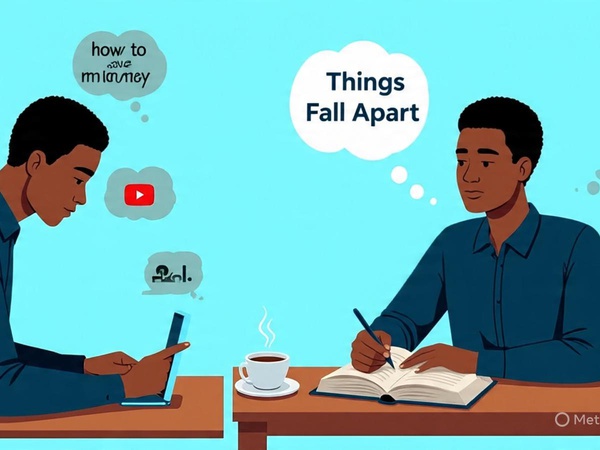
<blockquote><strong style=""><sub>Nicholas Carr once said What the Net does is shift the emphasis of our intelligence away from what might be called a meditative or contemplative intelligence and more toward what might be called a utilitarian intelligence The price of zipping among lots of bits of information is a loss of depth in our thinking.”</sub></strong></blockquote><p><sub><br/></sub></p><p><sub>What does that mean? </sub></p><p><sub><br/></sub></p><p><sub>Meditative intelligence is when you sit down and think about something. You read something you. Think about it and then you think some more. That is how you really understand things.</sub></p><p><sub><br/></sub></p><p><sub>On the other hand utilitarian intelligence is when you just want a quick answer. You want to know something now so you can move on to the next thing. It is like when you search for something on Google like "how to boil an egg". Then you close the page.</sub></p><p><sub><br/></sub></p><p><sub>Carr is saying the internet is making us choose fast thinking over deep thinking. And when we keep jumping from one post to another, we stop thinking deeply. That’s the price. </sub></p><p><sub><br/></sub></p><p><sub>So has social media replaced books as the real driver of knowledge and influence? </sub></p><p><sub><br/></sub></p><p><sub>For influence, yes. That one is clear. </sub></p><p><sub><br/></sub></p><p><sub>One video started <a class="tc-blue external-link" href="https://twocents.space/insights/tag/endsars" rel="noopener noreferrer" target="_blank">#EndSars</a>. One tweet can make the whole country talk about one person for 3 days. One TikTok can make a new slang spread in one week. </sub></p><p><sub>Social media decides what we talk about today. It’s fast. Books cannot do that now. </sub></p><p><sub><br/></sub></p><blockquote><sub>But Carr gave another warning. He said: “In the long run, the Net may well turn out to be the greatest medium for mental junk food that we’ve ever invented.” </sub></blockquote><p><sub><br/></sub></p><p><sub>Mental junk food. That’s it. </sub></p><p><sub><br/></sub></p><p><sub>I have done it myself. I shared a post about “how to save money” and if you ask me to explain it now, I will just laugh. I watched a 1 minute video about “signs you’re stressed” and felt okay for 1 minute. Then I scrolled and forgot. </sub></p><p><sub><br/></sub></p><p><sub>That is not knowledge. That is just zipping. </sub></p><p><sub><br/></sub></p><p><sub>You can’t zip through Things Fall Apart and understand Okonkwo. You have to read from the beginning. The wrestling, the farm, the exile, up to the end. </sub></p><p><sub><br/></sub></p><p><sub>Books make you sit down. Social media makes you keep moving. </sub></p><p><sub><br/></sub></p><p><sub>A tweet can be deleted. A video can be changed. But a book you read last year still has the same words on page 50. Nobody can change it after you’ve read it. </sub></p><p><sub><br/></sub></p><p><sub>But the other side of this argument is strong.</sub></p><p><sub>There’s a case that social media has replaced books for knowledge too. And it’s worth hearing.</sub></p><p><sub><br/></sub></p><p><sub>First books can be slow. Not everyone has access to them. That is true. A book can cost a lot of money. Data for a week can teach you many things. YouTube has lectures from Harvard and TikTok has doctors explaining things in short videos. For some people social media is the only way they can learn.</sub></p><p><sub><br/></sub></p><p><sub>Second social media can also be deep and meaningful. There are threads that explain things better than my teacher did in school. There are long videos that explain important topics like trauma, history and science. Not everything on media is quick and superficial. Some creators really teach you things. If you follow the people you can learn a lot.</sub></p><p><sub><br/></sub></p><p><sub>Books can also be useless. Not every book is deep and meaningful. Some books lie. Some books are boring and teach you nothing. Just because it is printed does not mean it is true. </sub></p><p><sub>So maybe the problem is not media versus books but how we use them.</sub></p><p><sub><br/></sub></p><p><sub>I will give you an example. I saw a thread about "3 Money Habits That Keep You Broke". I read it. I retweeted it. Said "yes this is me". I felt smart for a minute Then I scrolled and forgot. I did not change my habits I did not save any money. That’s utilitarian intelligence. Fast label, no depth.</sub></p><p><sub><br/></sub></p><p><sub>My friend Victor did something different. He saw the thread and then he went and bought a book on personal finance He read one chapter every night for a month. He opened a spreadsheet to track his money. He called me to cancel our shawarma plan. That’s meditative intelligence. He didn’t just zip. </sub></p><p><sub><br/></sub></p><p><sub>So the question is real. Social media can teach us things and books can fail. The tool is not the problem we are.</sub></p><p><sub><br/></sub></p><p><sub>Here is why I still agree with Nicholas Carr.</sub></p><p><sub><br/></sub></p><p><sub>Even if social media can teach us things it does not want to. The app is designed to make us skip through things quickly. The algorithm rewards superficial content, not deep and meaningful content. You have to fight the app to learn something. With books you have to fight yourself to stop learning.</sub></p><p><sub><br/></sub></p><p><sub>That is the difference.</sub></p><p><sub><br/></sub></p><p><sub>So did social media replace books?</sub></p><p><sub><br/></sub></p><p><sub>For influence yes. It owns what we talk about.</sub></p><p><sub><br/></sub></p><p><sub>For knowledge no. Not yet. Because we are still skipping through things quickly, We chose thinking over deep thinking. We chose junk food over real food.</sub></p><p><sub><br/></sub></p><p><sub>Nicholas Carr was right The internet changed us.</sub></p><p><sub><br/></sub></p><p><sub>We have more information than our parents had but we do not think more deeply, than them.</sub></p>


 90
90






Other insights from Xallyheart












Referral Earning

Points-to-Coupons

Insights for you.







THE MEETING
Sometimes it takes one meeting for our lives to change forever. It was never Femi'...
1379 views
14 upvotes
15 comments


OMÓ ÉSAN
They say the apple does not fall far from the tree, but I was the exception, or I was s...
1342 views
15 upvotes
10 comments





























Comments