Score |
130







Before The Algorithm They Were Hands.
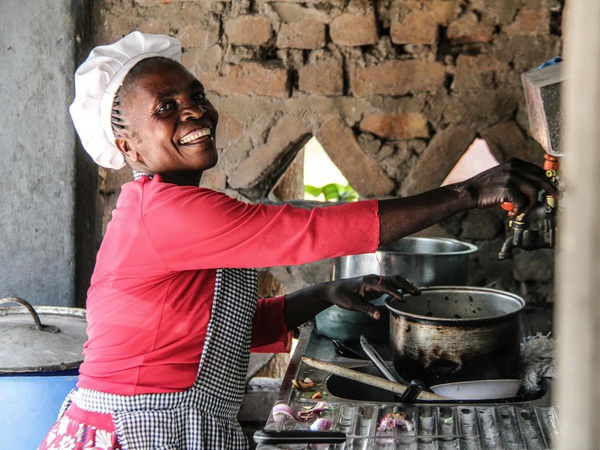
<p>My mother has never used a laptop.</p><p>She runs a catering business from her phone. Orders come in on WhatsApp. Payments land on her account before the food does. She negotiates with suppliers over voice notes, tracks her stock in a battered notebook, and somehow somehow remembers every client's preference without a single spreadsheet.</p><p>She built it herself. One pot at a time. One wedding, one birthday, one corporate lunch at a time.</p><p>And every time someone asks me "what future does Africa have in the digital economy?" I think about her hands. Stirring,Seasoning, and Showing up.</p><p>Because the honest answer is we were never really inside it to begin with.</p><p>The digital economy wasn't built for us.</p><p>It was built somewhere else, scaled somewhere else, and then shipped to us like a solution to a problem nobody asked us to define. We arrived late, adapted fast, and the world called it inclusion. But adaptation is not the same as ownership. Using a tool is not the same as holding it.</p><p>For a while, there was a middle ground. Data entry. Transcription. Virtual assistance. Customer service roles that millions of young Africans quietly stitched together into something resembling a living. The outsourcing economy became our own quiet hustle not glamorous, not secure, but ours.</p><p>AI is eating that middle now.</p><p>Not loudly. Just slowly, steadily, the gigs are thinning. The platforms are automating. The companies that used to hire fifty people to do what one model now does in seconds are doing the math. And the math is not in our favour.</p><p>Everyone's response? Upskill.</p><p>As if a Coursera certificate is the antidote to structural exclusion. As if the problem was always that we just didn't know enough not that the systems were never designed to let us in.</p><p>I'm tired of upskill being the answer to every question that should make us uncomfortable.</p><p>Here's what nobody says out loud:</p><p>AI doesn't just replace jobs. It replaces the entry points. The low-barrier roles that let someone with no connections, no capital, and no safety net get a foot in the door. The jobs my generation used to save enough to start something real.</p><p>When those disappear, it's not just unemployment. It's the closing of a door that was already barely open.</p><p>And yet.</p><p>I'm not writing this from hopelessness. I want to be careful about that. Because African workers are not fragile. We are creative out of necessity we don't have the luxury of being anything else. We have hacked, pivoted, and improvised through every broken system this continent has thrown at us and kept moving.</p><p>My mother never had a business loan. No startup capital. No accelerator programme. She had a pot, a reputation, and the kind of consistency that no algorithm has figured out how to replicate.</p><p>She adapted, too. When she noticed that a short video of her food got more attention than a week of knocking on doors, she started filming. Blurry videos, bad lighting, rice steaming in the background. It worked. Her customer base grew. She didn't call it content marketing. She just called it showing people what she could do.</p><p>That's the African worker in a nutshell. Always finding the way in.</p><p>But there's a difference between surviving AI and thriving because of it.</p><p>Surviving looks like learning to use the tools before they replace you. Thriving looks like building the tools. Owning the platforms. Writing the policy. Sitting in the room where decisions about automation get made instead of reading about those decisions on Twitter after the fact.</p><p>Right now, most of us are on the wrong side of that line.</p><p>Not because we lack the intelligence. Not because we lack the hunger. But because the infrastructure the funding, the access, the networks is still concentrated in the same places it always was. And AI, for all its disruption, is mostly making those places richer.</p><p>The question isn't whether African workers will adapt to AI.</p><p>We will. Watch us.</p><p>The question is when we do, who benefits?</p><p>Who owns the model we're trained on? Who profits from the platform we build for? Who writes the terms and conditions we agree to because we need the gig?</p><p>My mother doesn't know what a large language model is.</p><p>But she knows that her jollof rice keeps people coming back. She knows that her reputation is her most valuable asset. She knows that no app, no shortcut, no automation can replace the trust she has spent years earning one plate at a time.</p><p>In a strange way, she's already ahead of the conversation.</p><p>The future of African workers in the digital economy doesn't live in the tools.</p><p>It lives in what we know that the tools don't. The relationships. The context. The cultural fluency. The ability to read a room, a client, a moment and respond like a human being, not a prompt.</p><p>That's not nothing.</p><p>That's actually everything.</p>



 117
117





Other insights from Quillnomzy












Referral Earning

Points-to-Coupons

Insights for you.


The Resource Curse
Whenever I think of the plight in Africa, a certain song from my childhood days comes t...
1920 views
9 upvotes
8 comments

BREAST IRONING
Ever heard of the breast ironing practice? well, I am from Cameroon and we have strong ...
1714 views
19 upvotes
24 comments


Africa is rich or poor ?!
To address the issue of poverty and underdevelopment in Africa, it is important to cons...
1375 views
7 upvotes
10 comments


CONCEDING SUPREMACY - THE OWN GOAL PH...
An African man would never agree to the notion that the whites are superior to us. The ...
1350 views
3 upvotes
2 comments

THE REAL WAKANDA IS THE DEMOCRACTIC R...
Sometimes life imitates art, other times art imitates life
The first time I watched...
1199 views
7 upvotes
9 comments

FOR MY WOKE BROTHERS
The death of the Queen of England, is no more breaking news. It's been a week since the...
1197 views
2 upvotes
2 comments

Why have African societies failed?
Where 2 or 3 Africans are gathered, conversations about our countries are sure follow. ...
1188 views
3 upvotes
3 comments


THE DEVIL'S IN THE DETAILS
How do you get someone reliant on you? To get them to follow your every instruction? Th...
837 views
6 upvotes
9 comments




Glory of the Colosseum
The glory of the Colosseum once symbolized the peak of human resilience, the fight for ...
777 views
2 upvotes
5 comments





























Comments